
Most leaders still talk about AI as if the hard part is the model.
They worry about math. They worry about hallucinations. They worry about picking the “right” LLM. All fair concerns, but they are rarely the deciding factor in whether an AI product delivers durable value.
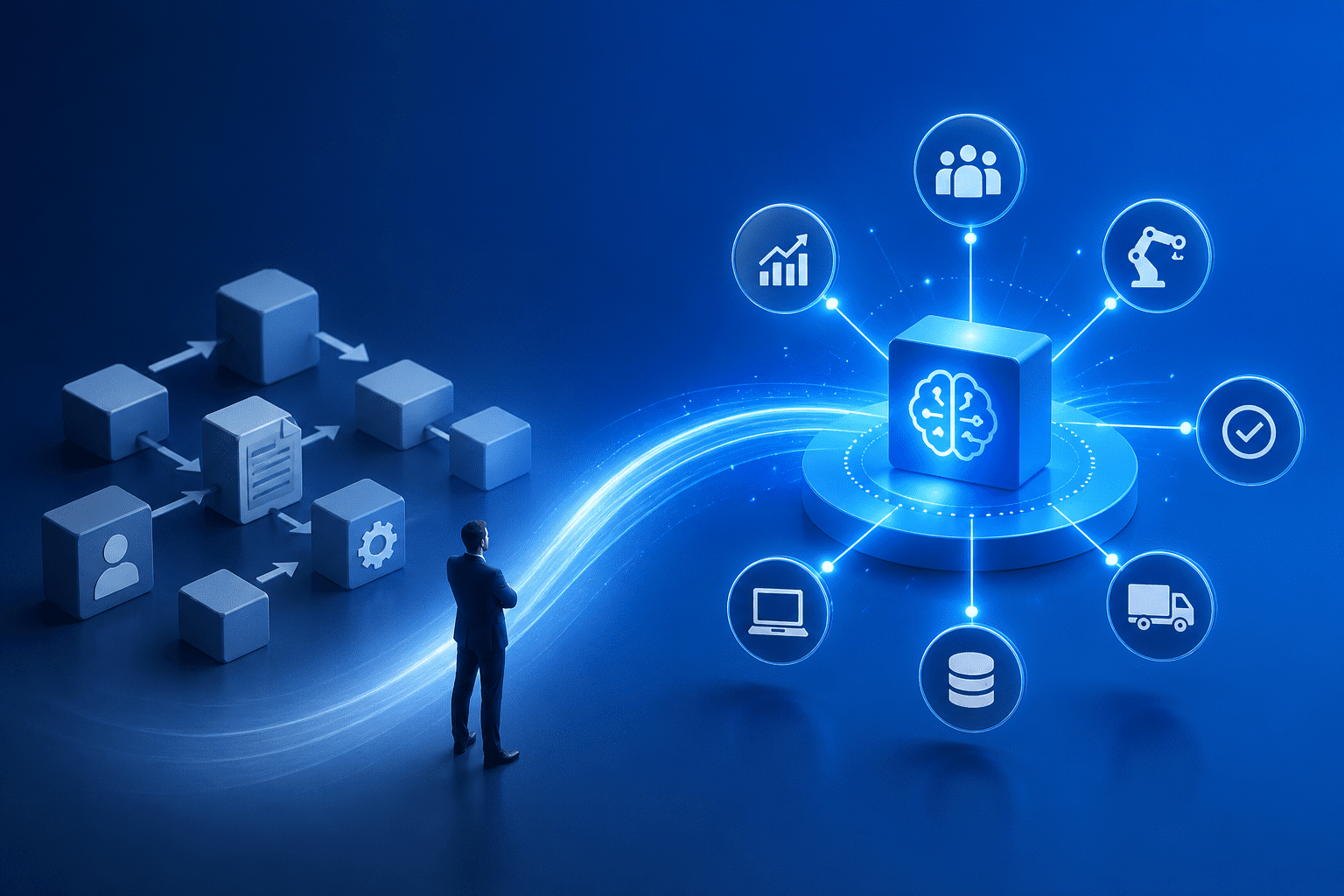
In enterprise environments, AI rarely wins or loses on intelligence. It wins or loses on its integration with your systems. If the AI cannot live within the end-to-end workflow and move cleanly across the existing systems, it stays a clever side tool.
Cuesta’s perspective has been consistent in its underlying principle: real value starts with the business problem and the path to outcomes, not with the novelty of technology. “AI is not a strategy. It’s a tool.”
Why do teams so often underestimate system integration as a critical requirement for AI success?
Integration with the existing systems is overlooked for a simple reason: people overvalue “new AI technology” and undervalue the operational work that makes it usable.
Two common bad assumptions show up again and again:
- “The AI is the hard part, integration is the easy part.”
- “We’ll bolt it into the workflow later.”.
A concrete example: Quote-to-BOM automation in manufacturing
In one engineering-heavy manufacturing environment we supported, the business challenge was not abstract.
A customer quote needed to be translated into a Bill of Materials (BOM), so the manufacturing floor could actually build the product. The catch was that the translation often relied on institutional knowledge more than clean documentation. Engineers knew the patterns, but the organization could not scale that knowledge efficiently.
The objective was not “generate a BOM with AI.” Rather, the objective was to:
- Extract quote-to-BOM patterns using AI, and
- Codify those patterns into a deterministic rulebook so BOM generation could be automated reliably and repeatedly.
This is the part many teams miss: in environments like this, the model is the accelerant. The rulebook, validations, and workflow integration are what make it operational.
Where integration becomes the product
To make quote-to-BOM automation real, the solution had to behave like an end-to-end workflow, not a standalone tool:
- Triggered in-take
New quotes must reliably enter the pipeline from the operational system where quotes originate. - Quote packaging and inference
Quote data must be structured consistently and sent to the model to identify quote-to-BOM patterns with clear data contracts. - Rules-driven BOM generation
Generate BOMs deterministically using the rulebook mined from AI, so outputs are consistent, testable, and explainable. - Human-in-the-loop review
Engineers need an approval step inside the normal engineering motion, not a separate “AI portal.” - Write-back with validations
The approved BOM and all associated metadata must move into the client database with proper validation, traceability, and controls.
This is why system and process integration matters: it is what turns a correct output into an executed outcome.
How we think about AI: product first, integration by design
At Cuesta, we push a product lens on AI from the start.
- Who is the user?
- What decision or task are we changing?
- What outcome do we expect, and how will we measure it?
- Where does this capability live inside today’s workflow?
That framing forces a simple truth: the “AI product” is not a model. It is an integrated capability that works seamlessly inside the current operating environment. This is the same logic behind starting with business impact and data readiness, not buzzwords.
Conclusion
To significantly improve the chances that your “AI initiative” evolves into a lasting capability, treat process and system integration as a primary product requirement rather than a downstream engineering task.