


Do We Still Need to Organize Data Before Running AI?
For years, the first step in any serious AI initiative has been the same: fix the data first. When companies approach consultants asking where AI can automate processes or generate insight, the answer almost always starts with a data project. Build a scalable data model. Modernize the data platform. Standardize pipelines and connectors. Retire fragile legacy infrastructure. The logic is straightforward – AI is only as good as the data it can access.
But the rise of agentic AI systems raises a question if companies still need to organize all data before AI can use it? The answer is becoming more nuanced.
Part A) Traditional Approach to AI
Most enterprise data is not neatly stored in databases. It lives in emails, PDFs, notes, chat logs, contracts, and long notes in CRM systems like Salesforce. Much of it is scattered across internal tools and knowledge repositories. Historically, making this data usable required extensive data engineering work. AI has already improved this process dramatically. Modern AI systems can act like “1,000 analysts,” reading large volumes of unstructured text and extracting structured information. Contracts can be parsed. Support tickets can be categorized. Emails can be summarized and tagged.
This makes previously inaccessible information searchable, reusable, and analyzable. But the traditional workflow still assumes a clear sequence, starting with ingesting and organizing data in one place, building a scalable data platform, then running AI models on top. In practice, many companies struggle even with step one. Legacy systems like on-premise SQL servers often become expensive to maintain, difficult to query, and prone to inconsistent data definitions. As a result, many AI projects stall before they begin.
Part B) Agentic AI
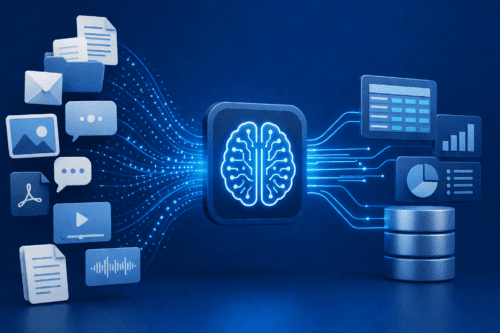
Agentic AI introduces a different possibility. Instead of requiring all information to be centralized and structured first, AI agents can dynamically access and reason over raw data sources, reading documents, querying APIs, and pulling context as needed. In theory, this allows AI to operate directly across email threads, PDFs, knowledge bases like SharePoint, and CRM platforms without requiring everything to be modeled in a data warehouse first. For some use cases such as internal search, research assistance, or workflow automation, this approach can work surprisingly well.
This changes the traditional sequence of AI projects. Instead of waiting for perfect data architecture, companies may begin extracting value directly from messy information while modernizing their data platforms in parallel. But this approach also introduces new challenges.
Part C) Where the Data Foundation Still Matters
Agentic approaches can struggle when organizations require precision, consistency, and accountability.
First, many companies depend on consistent metrics and standardized reporting. Financial KPIs, revenue numbers, and operational dashboards must produce the same answer every time. If AI agents pull information dynamically from multiple documents or systems, variations in interpretation can lead to different answers to the same question which is unacceptable for executive reporting.
Second, some processes require high-accuracy operational decisions. In areas like pricing, credit assessment, or supply chain planning, even small errors can have financial consequences. While LLMs are strong at reasoning over text, they cannot always guarantee the level of precision required for these decisions.
Third, regulatory and auditability requirements add another layer of complexity. Heavily regulated industries such as financial services and healthcare require organizations to trace exactly how a decision was made and which data sources were used. When AI systems dynamically retrieve and synthesize information across documents, maintaining a clear audit trail becomes difficult.
The limitations become more pronounced when AI is used for prediction rather than interpretation. In practice, most high-value use cases such as demand forecasting, outcome prediction, and customer segmentation depend on models trained on structured, well-governed datasets. These models require clearly defined variables, consistent data definitions, and clean historical records to function reliably. Unlike agentic systems, which can navigate ambiguity in unstructured sources, predictive models are highly sensitive to inconsistencies and noise. If the underlying data is fragmented or poorly standardized, the model may not just underperform, it can produce systematically misleading results.
Finally, trust remains a practical challenge as LLMs are prone to hallucinations and can generate false confidence. Without guardrails such as retrieval grounding, citations, and human review, organizations risk relying on answers that are difficult to verify.
For these reasons, agentic AI is often most effective as a layer on top of existing data foundations, rather than a replacement for them. The future will likely be hybrid, where structured data platforms support core operations, while AI agents navigate the vast universe of unstructured information around them.